02 · Signal processing · Machine learning
Adversarial Robustness of Learned Doppler Estimators for VLEO Satellite Communications
Machine-learning estimators are being proposed to correct the extreme Doppler shift on Very Low Earth Orbit satellite links. This thesis asks the uncomfortable follow-up question: what happens to them when conditions are adversarial rather than benign?
BEng(Hons) thesis, University of Cape Town
Context
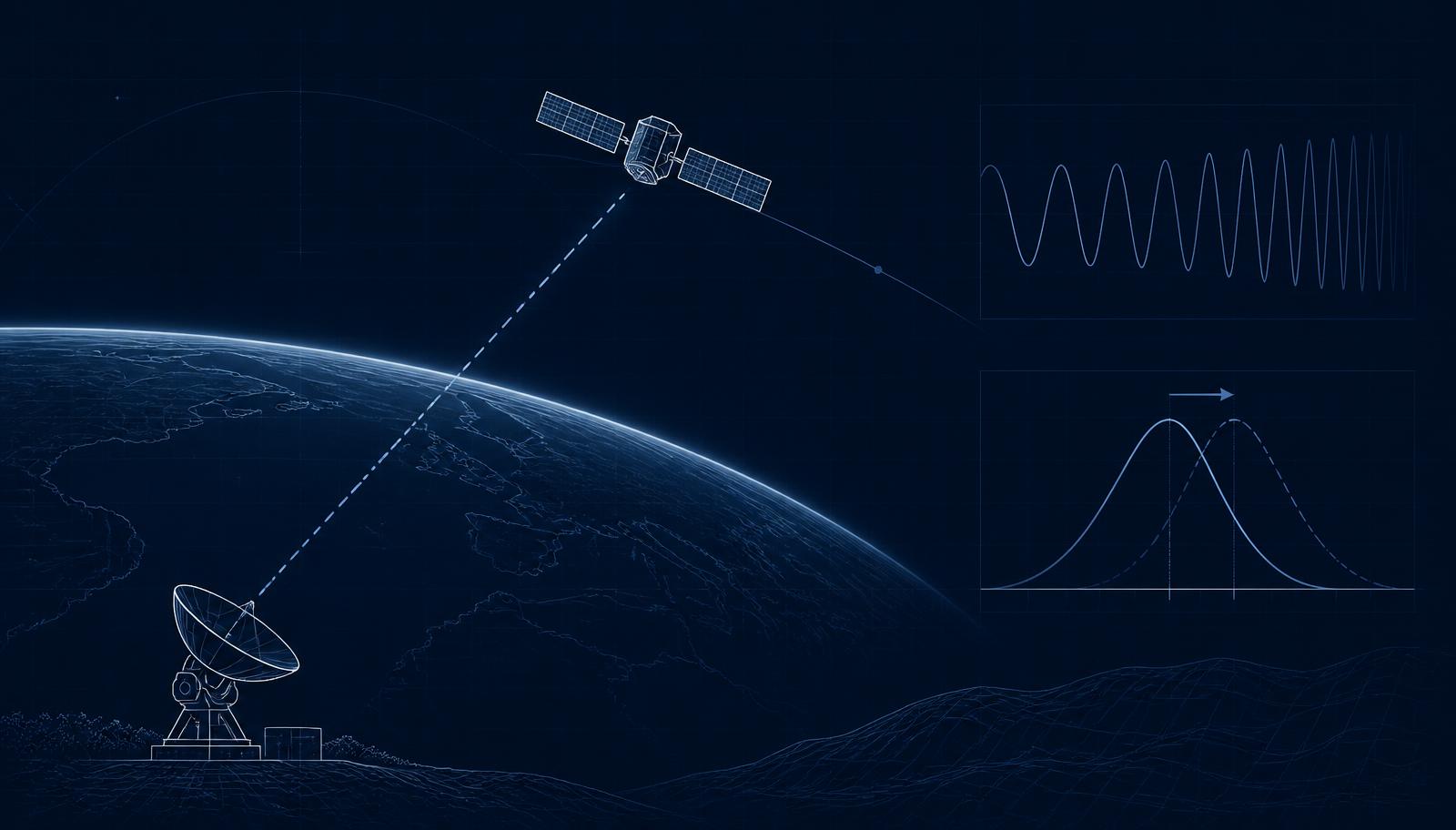
A satellite in Very Low Earth Orbit crosses the sky fast enough to impose a carrier frequency offset far larger than terrestrial systems ever contend with, and the offset changes rapidly during a single pass. Random access synchronisation — the PRACH procedure — has to resolve that offset before a link can be established, and it must do so even when GNSS assistance is unavailable or untrustworthy.
What the project does
The work reproduces a published dual-head temporal convolutional network architecture for GNSS-resilient PRACH synchronisation, then subjects it to conditions the original evaluation did not cover: adversarial perturbation of the received signal, and non-ideal channel and impairment models.
The learned estimator is benchmarked directly against classical CFO estimation techniques, so the comparison is not just accuracy under ideal conditions but graceful degradation under stress — which matters far more for a link you cannot service in orbit.
Why it matters
If a learned estimator outperforms classical methods on average but fails catastrophically under a modest adversarial perturbation, then deploying it in a non-terrestrial network trades a well-understood error floor for an unbounded one. This thesis is about characterising that trade rather than assuming it away.
Skills exercised
Fourier analysis and matched filtering, OFDM and PRACH waveform structure, orbital Doppler modelling, time-series deep learning, adversarial machine learning, and a lot of careful reproduction work — reimplementing someone else's published architecture faithfully enough that a robustness result can be trusted.